Amsterdam, March 18, 2026 – Shifting skills requirements, accelerating demographic change, and the rise of artificial intelligence are reshaping jobs and putting pressure on organizations across Europe to transform their workforces. Yet despite rising investment in HR technology and analytics, most companies still struggle to turn workforce data into meaningful decisions about skills, talent, and future capacity.
According to a new study by management and technology consultancy BearingPoint, many organizations are caught between strategic ambition and operational reality when it comes to data-driven skills and talent management. While HR leaders recognize the importance of evidence-based workforce decisions, nearly one-third of organizations still lack systematic data integration or reporting, limiting their ability to generate reliable insights and steer workforce transformation effectively.
Organizations are investing heavily in HR technology, but many are still steering their workforce with incomplete and delayed information.The challenge is no longer whether data exists. It is whether companies can unify it, trust it, and use it to make better decisions about skills, capacity, and future workforce needs.
Tobias Liebscher, Partner at BearingPoint

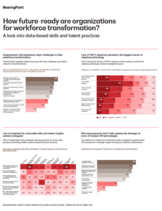
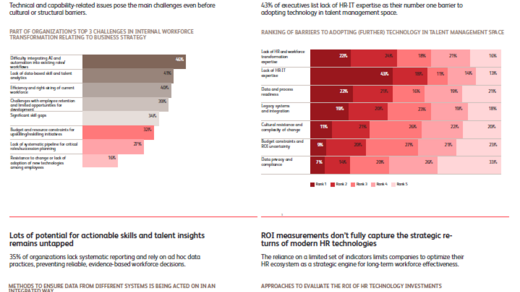
The “People and Tech: How future-ready are organizations for workforce transformation?” report draws on insights from 414 senior HR leaders across Europe. It finds that technical and capability-related issues, particularly integrating AI and developing data-driven skills and talent insights, now pose the main obstacles even before cultural or structural barriers, such as resistance to change or lack of adoption.
Key findings:
- 46% cite difficulty integrating AI into existing roles and workflows as a top-three challenge, and 41% report a lack of data-based skills and talent analytics, indicating that technical and capability gaps come before cultural barriers.
- Nearly one-third of the organizations lack the ability to systematically leverage data across systems, as integration remains ad hoc or manual, preventing reliable, evidence-based workforce decisions.
- While 45% use AI or analytics platforms to generate insights across systems, only 14% consistently connect and act on that data, revealing a significant execution gap between analytics and decision-making.
From HR technology to workforce impact remains unfinished business
The study shows that many organizations continue to map skills, assess capabilities, and size their workforce through disconnected, manual processes. Critical information is often stored in spreadsheets, updated infrequently, and rarely linked to business strategy. As a result, nearly one-third of organizations cannot meaningfully leverage AI or advanced analytics, even when such tools are technically available.
At the same time, HR leaders rate the strategic value of their HR systems highly. 80 percent say HR technology delivers clear business benefits, particularly in decision-making speed and administrative efficiency. This contrast reveals a widening execution gap: while systems are improving, the ability to integrate data across platforms and embed insights into everyday decisions remains limited.
Workforce transformation fails because insights stop at the dashboard. To create real impact, organizations must move from reporting to action. That means embedding skills data and analytics directly into workforce planning, talent decisions, and leadership routines.
Olivier Parent du Chatelet, Partner at BearingPoint

Toward skill-powered, evidence-based organizations
The report concludes that future-ready organizations will not be defined by the number of HR systems they operate, but by their ability to integrate fragmented technology landscapes, establish reliable talent data foundations, and consistently translate analytics into operational and strategic decisions.
To achieve this, BearingPoint identifies six critical steps, ranging from building skills architectures and unified data foundations to operationalizing insights in workflows and strengthening HR and leadership capabilities for data-driven decision-making. Organizations that succeed in this shift will be better positioned to anticipate skill gaps, proactively steer workforce transformation, and link talent strategies directly to business performance.
About the study
The study, conducted in October 2025, is based on a survey of 414 senior HR and transformation leaders across Europe, representing a wide range of industries and company sizes. Respondents include CHROs, HR directors, HR technology leaders, and senior strategy and transformation executives. The research examines current practices, barriers, and priorities in HR technology, skills management, and workforce transformation.
Download the full study here.
About BearingPoint
BearingPoint is an independent management and technology consultancy with European roots and a global reach that transforms businesses using technology intelligently. The firm operates across three core units: Consulting, Products, and Capital. Its Consulting services focus on selected areas, combining business and technology expertise with profound industry knowledge. The Products unit provides IP-driven solutions and managed services for business-critical processes. Capital delivers deal advisory and transaction services. In addition to its core operations, BearingPoint runs two joint ventures: Arcwide, a JV with IFS, which specializes in business transformation based on IFS technology, and BearingPoint North America, a JV with ABeam, which is dedicated to consulting excellence and business transformation built on SAP.
BearingPoint serves many of the world’s leading companies and organizations. Together with its strategic alliance partner ABeam Consulting, the firm brings together 15,000 professionals and supports clients in over 70 countries, delivering seamless business transformation with sustainable impact.
BearingPoint is a certified B Corporation, driven by a strong sense of purpose – today and into the future.
For more information, please visit:
Press contact
Alexander Bock
Global Senior Manager Communications
Telephone: +49 89 540338029
-
 Alexander BockPublic Relations